
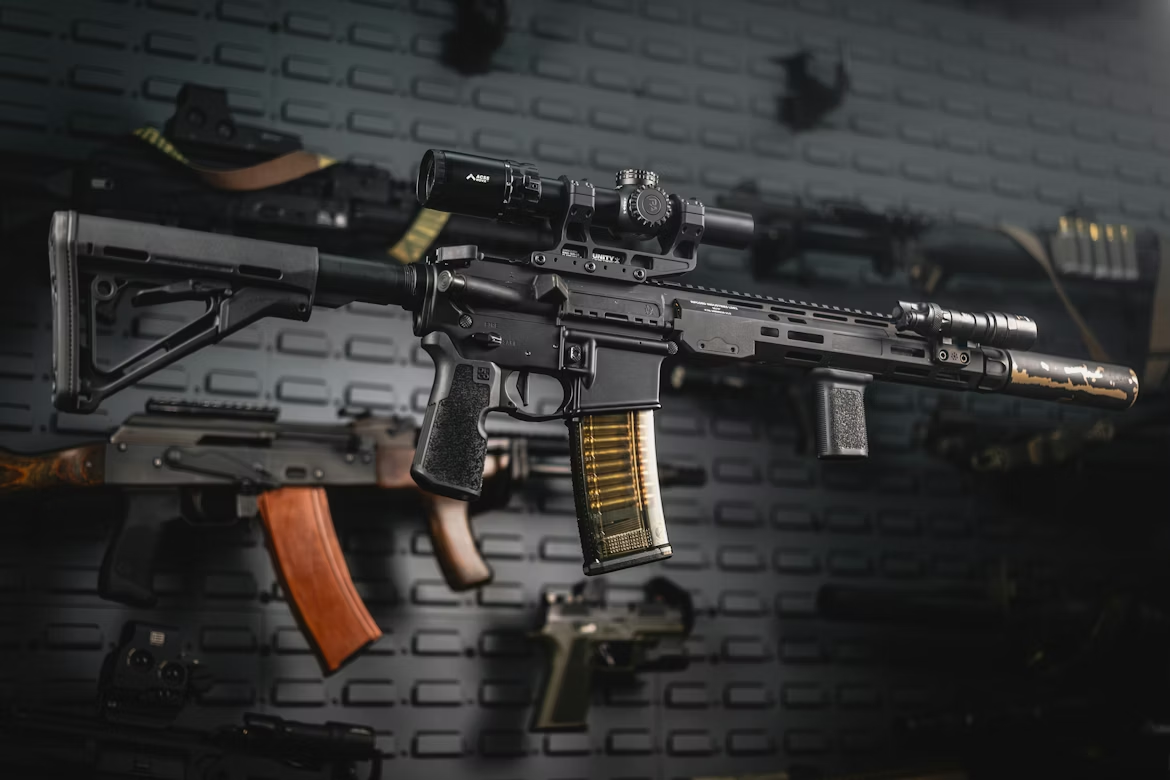
U.S. Citizens Buy Half a Million Suppressors in 90 Days
For nearly a century, the federal government treated suppressors like gangster contraband instead of what they actually are: hearing-protection devices attached to the end of a firearm. The public was fed Hollywood mythology, federal law kept a 1934 tax scheme in place, and ordinary gun owners were told to pay $200, submit paperwork, wait on ATF, and pretend that muffling a gunshot was somehow more suspicious than protecting your ears. The term “silencer” was coined, even though they do not silence anything. A suppressor and silencer are the exact same thing, one just sounds scarier to the ignorant than the other.
Then the tax went to zero.
As of the most recent federal data, there are now 5,998,065 registered suppressors in the United States, up from roughly 5.7 million just a few months earlier. That means hundreds of thousands of new suppressors entered the registry in a matter of weeks.
According to the latest data through March 31, 2026, Americans filed 144,735 suppressor transfer applications in March alone. In just the first three months of the year, that number climbs to over 557,000 Form 4 submissions tied largely to suppressors. Total NFA eForms across all categories pushed close to a million in that same window.
Before 2026, ATF processed roughly 2,500 NFA submissions per day. March alone averaged closer to 4,600 suppressor applications per day. Not total NFA items. Just suppressors.
The Tax Was the Barrier
Nothing about suppressors fundamentally changed on January 1, 2026. They didn’t become quieter or more capable, or suddenly appear on the market.
What changed was the artificial barrier.
For nearly a century, the federal government imposed a $200 tax on suppressors under the National Firearms Act. In 1934, that was intentionally punitive, a backdoor prohibition.
And once that cost disappeared, demand flooded in immediately. The first day of the new system reportedly saw around 150,000 eForm submissions, compared to a normal daily volume of roughly 2,500.
What Suppressors Actually Do
The public narrative around suppressors has always been driven by fiction. Whisper-quiet gunshots. Criminal tools. Something only government enlisted snipers or mobsters would want.
Gunfire commonly reaches 150 to 165 decibels, a range that can cause immediate and permanent hearing damage. Suppressors bring that down, often by 20 to 30 decibels, which is significant, but not silent. Most firearms still produce well over 130 decibels even with a suppressor attached.
They also reduce recoil, soften concussion, improve control, and make shooting more manageable for new shooters and smaller-framed individuals. For hunters, they reduce the risk of hearing damage in the field where ear protection is rarely used. For anyone around the shooter, they reduce the impact of the blast.
Major medical organizations, including groups representing ear, nose, and throat specialists, have publicly supported suppressor use as a hearing protection tool.
States Are Starting to Catch Up
As ownership surges, some states are beginning to adjust their laws to reflect reality.
In 2026, Larry Rhoden signed legislation removing suppressors from South Dakota’s definition of “controlled weapons,” eliminating redundant state-level treatment and aligning more closely with federal law.
In Ohio, lawmakers advanced legislation that would remove suppressors from the state’s “dangerous ordnance” classification. The bill passed the Senate with overwhelming support and is part of a broader effort to normalize suppressor ownership under state law.
Other states are still debating similar changes, including proposals to expand legal use or clean up outdated statutory language.
But not every state is moving in that direction.
Suppressors remain prohibited for civilian ownership in states like California, New York, New Jersey, Illinois, and a handful of others. In some places, lawmakers are going the opposite direction. A 2026 proposal in Virginia sought to impose a $500 state tax per suppressor, effectively trying to recreate the same barrier the federal government just removed.
The Narrative Is Breaking
For years, suppressors were framed as rare, suspicious, and unnecessary. But the discussion among the public as of late is shifting perception more toward reality.
Some European countries have long considered suppressors a safety tool. In Norway for example, you can walk into a store and by a suppressor alongside ammo. And they’re plentiful. Many other countries with the strictest gun laws consider suppressors an accessory. The fear around them is very much due to the United States government’s propaganda machine.
At the end of the day, the smartest policy for the United States would be full deregulation of suppressors. Let’s keep pushing toward smart policy.
Stay ready. Stay loud.
Colorado gun owners aren’t going down without a fight.
Make a donation of $10 or more and get your choice of a sticker below.


Help Us Hold the Line
We read every bill, track every hearing, and expose every attack on your rights.
Your donation powers the tools, outreach, and real time education to stop this madness.
The Second Amendment doesn’t defend itself. We do.
See you in January