
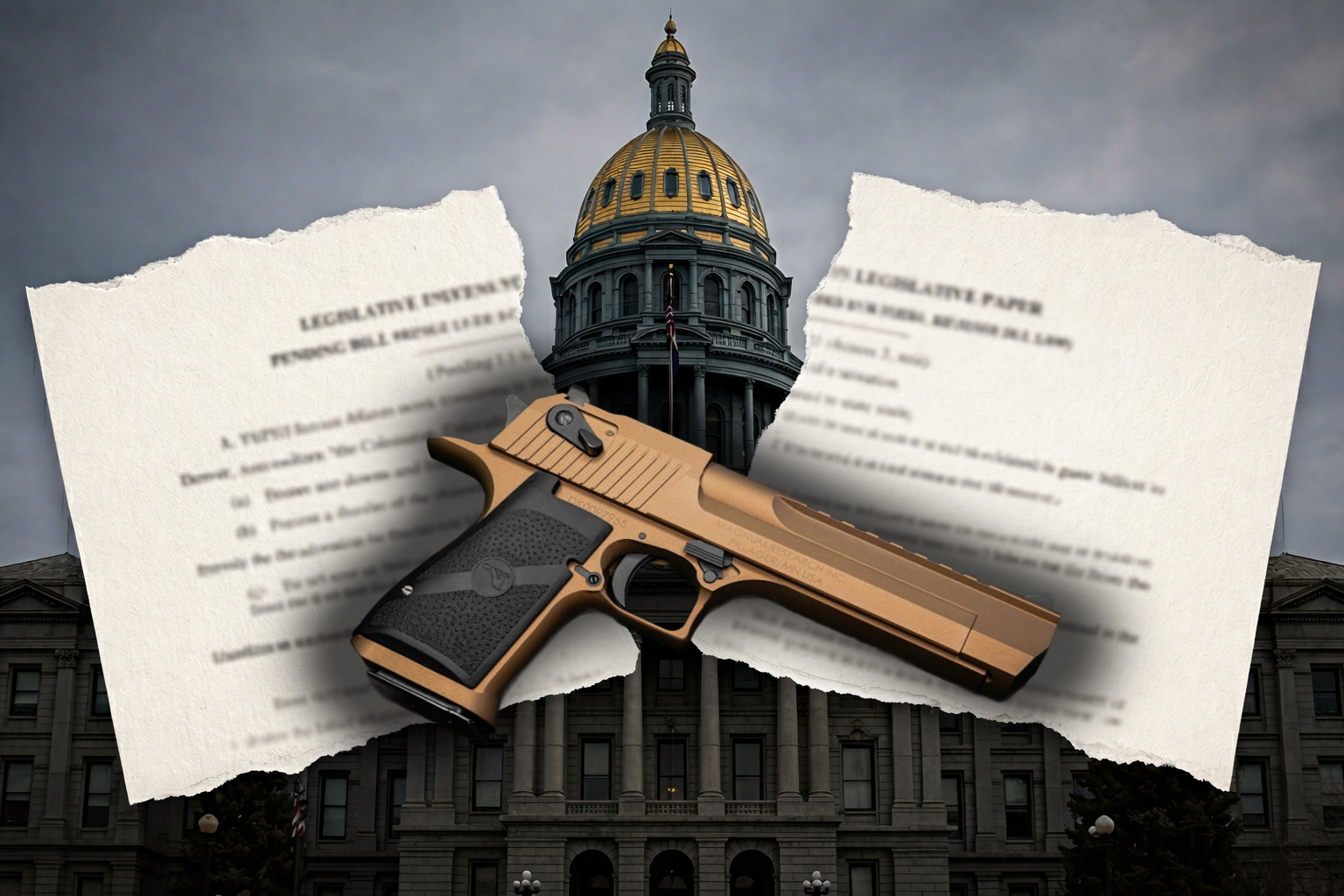
Four Gun Control Bills Advance in One Day at the Colorado Capitol, One Pro-2A Bill Killed
March 2nd was a long day at the Colorado Capitol.
By the time lawmakers adjourned that day, it was well after midnight. Four separate gun control bills had advanced and one bill protecting constitutional rights was killed on a party-line vote.
Here’s what moved.
SB26-043 — Firearm Barrel Restrictions & Registry
SB26-043 passed the Senate 19–16, with every Republican and four Democrats voting no. The bill must still pass the House chamber before it would go to the Governor for signature or veto.
The bill forces firearm barrel purchases to go through federally licensed gun dealers (FFLs), effectively banning private transfers between individuals and routing all online sales through a FFL. Every barrel sale must occur in person at a licensed dealer, where the dealer is required to collect identifying information from the purchaser and record the transaction on a form created by Colorado Bureau of Investigation (CBI).
Those records must include the buyer’s name, address, date of birth, government-issued identification number, along with the the make, model, and caliber of the firearm the barrel is designed for or used in. Dealers must retain these records for at least five years. In practical terms, the bill constructs a registry for firearm barrels. That registry must be maintained by licensed dealers and accessible to the state, at all times, for any reason.
The legislation also requires dealers to verify that a purchaser is not prohibited from owning a firearm before completing a barrel tranaction. However, the bill does not clearly establish how that verification process is supposed to occur, creating immediate questions about whether Colorado’s existing firearm background check system can even be legally or practically used for a non-firearm component. And if it can’t, FFLs will be expected to comply with an impossible mandate.
The bill’s definition of a “firearm barrel” is written broadly, covering not only finished barrels but also items that can be “readily completed, assembled, or converted” into one. Opponents have warned that the language could sweep in unfinished or easily modified metal tubing that was never manufactured as a firearm part.
Violations carry escalating criminal penalties for individuals, including misdemeanor charges with potential jail time and fines. FFLs face additional risk as failure to comply with the bill’s requirements would come with financial penalties and potential threats to their state dealers license.
Senate Amendments
The bill was amended in the Senate to better define “family member” as the bill carves out an exemption for certain classes of people, including family. Other exemptions include law enforcement and agents of the state.
We anticipate this bill running into the same real-world problems as Colorado’s magazine capacity limit, a law that legislative research itself has shown is unevenly enforced and disproportionately impacts minority communities based on conviction data. When laws are difficult to enforce universally, enforcement becomes selective. Selective enforcement opens the door to unequal enforcement.
SB26-043 now heads to the House, where it will receive a public hearing. Track the bill here.
HB26-1144 — 3D Printing & Digital File Restrictions
HB26-1144 passed the Colorado House on a vote of 40–25, with all Republicans and three Democrats voting against it. The bill must still pass the Senate before it would become law with the Governor’s pen.
The bill targets private firearm manufacturing by prohibiting the use of 3D printers, CNC machines, and other computer-controlled tools to produce certain firearm components. The restrictions apply to unfinished frames or receivers, magazines over 15 rounds, and rapid-fire trigger devices – all items whose possession is already illegal under Colorado law, and the manufacture of frames/receivers is banned under Colorado’s 2023 “Ghost Gun” statute.
The bill also moves firearm regulation into the digital realm, criminalizing the distribution and sharing of computer files used to manufacture those parts. Earlier versions of the bill went even further, also targeting the mere possession of those digital design files. After testimony exposed how broadly that language could reach, potentially sweeping in ordinary design files or unrelated digital content, lawmakers amended the bill and removed the possession ban, but the distribution ban remains.
House Amendments
An amendment passed in the House lowers the penalty for distributing digital firearm manufacturing files to a civil infraction (similar to jaywalking). As originally introduced, the bill treated file distribution under the same escalating criminal structure used in the manufacture portion of the bill: a Class 1 misdemeanor for a first offense escalating to a Class 5 felony for repeat violations. While the penalties were reduced for file distribution, the files themselves are still treated as a regulated category of digital contraband under state law.
Other amendments attempted to narrow the bill so it applies only to the specific firearm components already listed rather than potentially sweeping in a wider universe of gun parts.
Lawmakers also added an exemption for accredited gunsmithing programs, allowing those programs to manufacture or distribute the listed components strictly for instructional purposes.
Individuals or businesses that hold an FFL with a manufacturing license are exempt from the restrictions entirely.
Outside of those licensed manufacturers, the core structure of the bill remains intact: private individuals are prohibited from producing the listed components with computer-controlled manufacturing tools, and the distribution of the digital instructions used to manufacture them is now regulated under Colorado law.
HB26-1144 now moves to the Senate, where it will receive a public hearing. It has been assigned to the Senate State, Veterans & Military Affairs committee but a hearing is not yet scheduled. CLICK HERE to email that committee and ask them to oppose this bill. Track the bill here.
HB26-1126: New Dealer Regulations & Digital Registry
HB26-1126 advanced out of the House State, Civic, Military & Veterans Affairs Committee on an 8–3 party-line vote.
The bill expands Colorado’s firearm dealer regulatory system by requiring dealers to maintain detailed records of ALL firearm transactions and making those records available for inspection by the state. Dealers must record identifying information about the purchaser – including their name, age, and address – along with detailed information about the firearm involved in the transaction, such as the make, caliber, finish, and serial number, as well as the date of the transaction and the identity of the employee or individual who conducted the transfer
Unlike current law that requires a similar form to be completed for handgun purchases, HB26-1126 expands those requirements to include both handguns and long guns, as well as all firearm transactions, including sales, rentals, exchanges, and transfers. The bill also explicitly allows those records to be stored electronically, meaning transaction data can be digitized, rather than only maintained in a physical logbook as is the federal rule.
So basically, firearm transaction records can now be stored, searched, and accessed digitally, creating a system where purchaser information is preserved in a format that can be easily seized and reviewed by law enforcement and other agents of the state.
During debate, bill sponsors and proponents repeatedly described the bill as a “fix” to earlier dealer regulation laws. That is a lie. The bill does not narrow the prior law. It adds additional requirements on top of it.
House Amendments
The most significant amendments came in the security section of the bill.
Earlier versions placed rigorous security mandates directly into statute, outlining physical safeguards firearm dealers would be required to implement.
Those provisions were removed.
In their place, the amended bill grants the Department of Revenue (DOR) authority to determine dealer security requirements through rulemaking, meaning the standards will be written later by regulators with stakeholder input, rather than fixed in statute. But this also means the DOR may adopt requirements beyond what lawmakers debated in the bill itself.
HB26-1126 now moves to a vote of the full House chamber. Track the bill here.
SB26-004 — Red Flag Expansion Advances
SB26-004 passed the House State, Civic, Military & Veterans Affairs Committee on an 8–3 party-line vote.
The bill expands Colorado’s “Red Flag” Extreme Risk Protection Order (ERPO) system by adding new categories of people who can petition a court to have someone’s firearms to be seized by the state to include school staff, mental health workers, and other approved government agents.
Colorado’s red flag law already allows firearms to be confiscated through an ex parte civil court process without a criminal conviction, and without the person being red flagged even being aware the court proceedings are taking place. SB26-004 moves the state further toward a model where a growing list of third parties can trigger that legal process based on predictive risk assessments rather than criminal conduct.
The bill now moves to the full House for second reading, debate, and a chamber vote. Track the bill here.
HB26-1072 — Constitutional Firearm Protections
The final firearm bill heard was HB26-1072, introduced by Representative Scott Slaugh.
The bill would have codified constitutional firearm protections directly into Colorado statute, affirming that the right of law-abiding citizens to keep and bear arms cannot be restricted except in circumstances consistent with the Colorado Constitution, the U.S. Constitution, and longstanding historical tradition. In practice, the legislation was intended to reinforce constitutional standards in state law and provide clearer statutory protection against future firearm regulations that conflict with those principles.
HB26-1072 also proposed repealing Colorado’s existing “Red Flag” ERPO law.
The bill was ultimately killed on a party-line vote.
There were hours of testimony, with those in favor of protecting gun rights far outweighing those in opposition. Debate stretched past midnight.
While four bills expanding firearm regulation advanced in a single day, the lone bill aimed at strengthening statutory protections for constitutional rights was not allowed to move forward.
What’s Next
All of these bills will have additional public engagement opportunities but those are not scheduled yet. You should contact your elected officials via phone and email to ask they oppose these bills.
SB26-043 moves to the House for a public hearing.
HB26-1144 moves to the Senate for a public hearing. It has been assigned to the Senate State, Veterans & Military Affairs committee but a hearing is not yet scheduled. CLICK HERE to email that committee and ask them to oppose this bill.
HB26-1126 and SB26-004 advance to second reading, debate and a vote in the full House in the coming days.
We will continue track it all.
• Follow our Legislative Watch page.
• Sign up for our email list
• Share this article.
Stay ready. Stay loud.
Colorado gun owners aren’t going down without a fight.
Make a donation of $10 or more and get your choice of a sticker below.



Help Us Hold the Line
We read every bill, track every hearing, and expose every attack on your rights.
Your donation powers the tools, outreach, and real time education to stop this madness.
The Second Amendment doesn’t defend itself. We do.
See you in January