
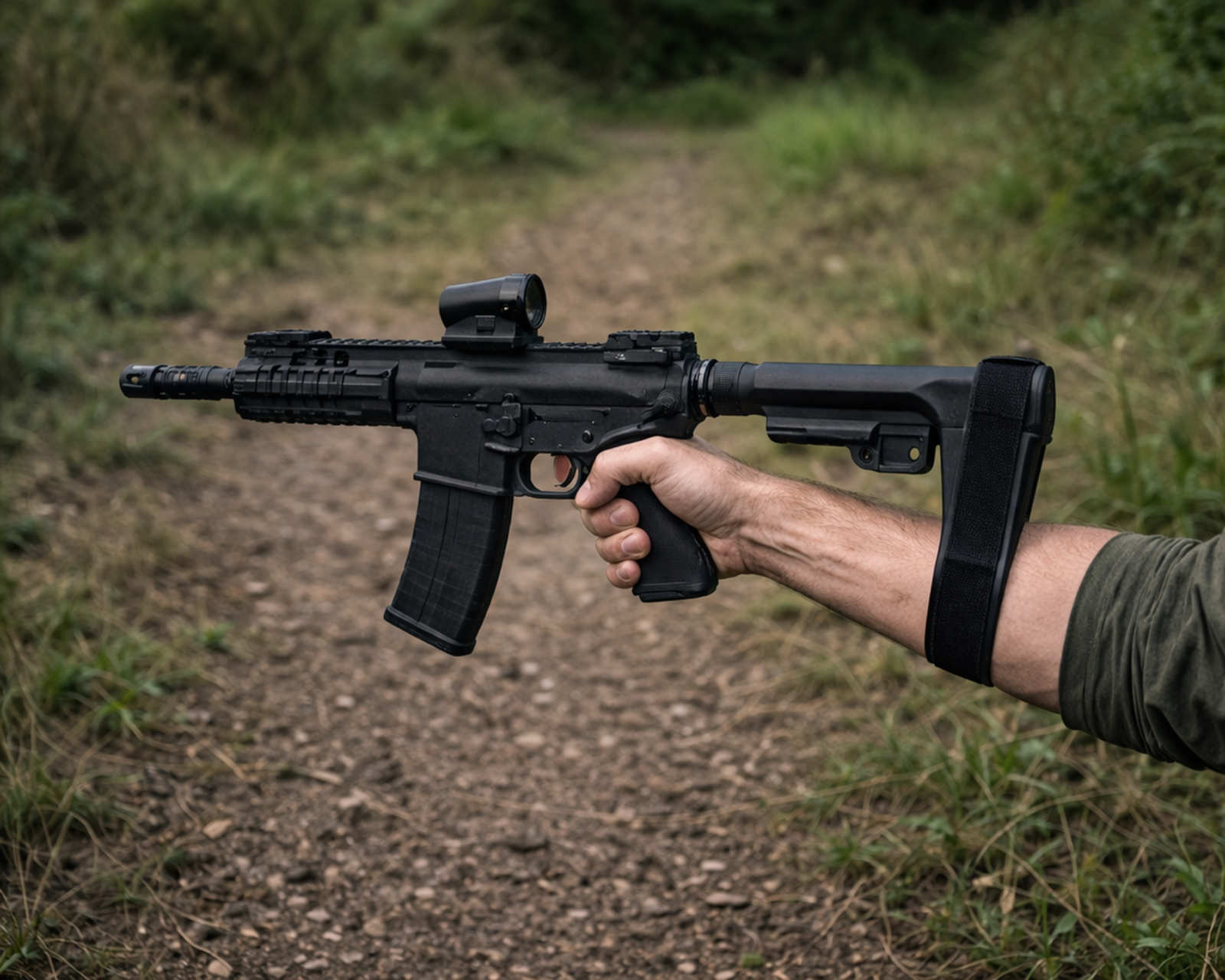
Dead Rule, Living Threat: ATF Still Claims Authority Over Braced Pistols
The Brace Rule Is Dead. The ATF’s Theory Is Not.
For gun owners who thought the death of the ATF’s 2023 pistol brace rule ended the brace fight, the federal government just delivered a colder message: the rule may be gone, but the agency still believes it can pursue some braced pistols as short-barreled rifles under the National Firearms Act (NFA).
That is the real significance of the March 16, 2026 filing in State of Texas v. ATF.
The Justice Department is asking the Southern District of Texas to dismiss the case as moot because another court’s nationwide vacatur of the brace rule already wiped the regulation off the books. But in making that argument, the government also reaffirmed something far more important than the procedural question in front of the court: it still claims authority to treat at least some brace equipped pistols as NFA regulated short-barreled rifles even without the 2023 rule in effect.
What Happened in State of Texas v. ATF
State of Texas v. ATF was one of the major challenges to the brace rule. The case was filed shortly after the rule took effect in 2023, arguing that the ATF had overstepped its authority by effectively rewriting federal law through regulation.
Early on, the court granted relief in part, recognizing that the rule exposed lawful gun owners to potential felony charges based on a shifting and unclear standard. The case was moving toward a full decision on the merits.
But before that could happen, another federal case vacated the brace rule nationwide. Once that happened, the government dropped its appeal in that case, and the rule was no longer enforceable anywhere.
That’s what led to the DOJ’s latest move. With no rule left on the books, the government is now arguing that State of Texas v. ATF should be dismissed entirely, without the court ever ruling on the underlying interpretation.
But that also avoids a direct legal decision on whether the ATF’s theory itself is lawful.
What the Rule Did and Why It Fell Apart
In 2023, the ATF moved to classify many pistols equipped with stabilizing braces as short-barreled rifles. That classification carries federal registration requirements and criminal penalties under the NFA. The rule put millions of gun owners at risk based solely on how their firearm was configured.
The ATF described it as a classification issue. In practice, it expanded how existing law would be applied without Congress passing a new statute. Courts rejected the rule. It was struck down as arbitrary, and the government later dropped its appeal. By 2025, the rule was no longer in effect.
The underlying interpretation, however, was never withdrawn.
What This Means Now
The government’s current position is that the statute still applies as it interprets it. If a firearm is considered “designed” or “intended” to be fired from the shoulder, it can still fall under the NFA’s definition of a short-barreled rifle. But without the rule, there is no published framework explaining how that determination is made. The criteria that were laid out in 2023 are gone, but the interpretation apparently remains – because the government says so.
The result is that the case challenging that interpretation may never receive a final ruling, while the interpretation itself is still being asserted.
And enforcement must be done on a case by case basis.
The rule is gone. The interpretation remains. And a new battle begins.
Stay ready. Stay loud.
Colorado gun owners aren’t going down without a fight.
Make a donation of $10 or more and get your choice of a sticker below.



Help Us Hold the Line
We read every bill, track every hearing, and expose every attack on your rights.
Your donation powers the tools, outreach, and real time education to stop this madness.
The Second Amendment doesn’t defend itself. We do.
See you in January